


Ancient woodland at risk: community proposes 3% redesign of housing development to protect veteran trees
As governments across the UK face mounting pressure to build more homes without sacrificing ancient woodland and other irreplaceable natural habitats, a community campaign in Scotland believes it has identified a practical compromise that could help bridge one of the country’s most contentious planning debates.
Rather than opposing a major housing development, campaigners fighting to protect Hollybush Woodland in Paisley are asking whether redesigning around 3% of the approved Abercrombie Park development could protect part of an ancient woodland containing registered veteran trees and important wildlife habitat, while still allowing around 97% of the planned homes to be built.
The proposal, developed with support from independent ecological advice, is intended not simply as a solution for one site, but as a potential example of how housing delivery and environmental protection can work together rather than being presented as competing priorities.

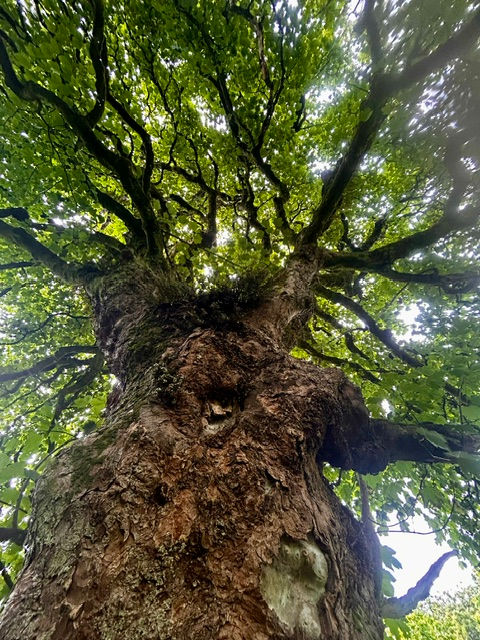
Hollybush Woodland contains approximately 20 veteran trees, including at least 12 recorded on the Woodland Trust’s Ancient Tree Inventory, together with areas of ancient riparian woodland that have developed naturally alongside a watercourse over hundreds of years.
Veteran trees and ancient woodland provide complex habitats for birds, mammals, insects, fungi and other wildlife. Their soils, root systems and ecological relationships have developed over centuries and cannot simply be recreated by planting replacement trees elsewhere.
Construction is already under way elsewhere on the former Dykebar Hospital site, but work within Hollybush Woodland is not expected to begin until after the bird breeding season ends in autumn. Campaigners believe this creates a final opportunity for meaningful discussions before the woodland itself is affected.
A spokesperson for Protect Hollybush said: ‘Across Britain we are often told that communities have to choose between building the homes people need and protecting the natural places they value. We don’t believe those are the only two options.
‘We are not asking for this development to be abandoned or planning permission to be overturned. We are asking whether a relatively modest amendment to the approved plans could protect part of an irreplaceable woodland while still allowing almost all of the homes to be built.
‘If a practical compromise can be found here, it could provide an example for developments across the UK where communities and developers are trying to balance the need for new homes with the protection of important habitats.’
The campaign is inviting the consortium behind Abercrombie Park – Cala Homes, Barratt Homes and Bellway Homes – to meet with independent ecological advisers to explore whether relatively small design changes could reduce the environmental impact of the approved scheme while preserving the overwhelming majority of the development.
Campaigners say the woodland’s veteran trees are among its most ecologically valuable features.
Veteran trees are recognised as some of Britain’s richest habitats for wildlife, supporting hundreds of species of insects, fungi, birds and mammals. Features such as cavities, decaying wood, loose bark and extensive root systems can provide nesting, roosting, feeding and sheltering opportunities that younger trees cannot offer.
Ancient woodland is considered irreplaceable because its soils, fungi, plants and ecological relationships have evolved over centuries. Even where new trees are planted, the original habitat cannot be recreated within a human lifetime.
Independent ecologist Liz Parsons of Starling Learning said, ‘Ancient woodland is one of Britain’s rarest and most valuable habitats because it has developed over hundreds of years. Once it is lost, it cannot simply be recreated.
‘Veteran trees are equally important because they support complex ecosystems that younger trees cannot replace.
‘Where opportunities exist to reduce environmental harm while still allowing development to proceed, those opportunities deserve careful consideration. As housing demand continues to grow, finding practical ways of protecting irreplaceable habitats will become increasingly important.’
Planning Democracy, an organisation that promotes openness and public participation within Scotland’s planning system, has also written to the consortium encouraging discussions about the proposal.
Clare Symonds, director of planning Democracy, said: ‘Communities and developers are often presented as being on opposing sides, but good planning should always leave room for constructive discussion where better outcomes may still be achievable.
‘If relatively modest design changes could protect irreplaceable natural heritage while allowing almost all of a development to proceed, those possibilities should be explored.’
Campaigners believe the proposal also provides an opportunity for the consortium to demonstrate commitments already published by each of the three developers regarding sustainability, biodiversity and community engagement.
Across their respective sustainability strategies, the consortium members describe ambitions to enhance biodiversity, create thriving communities and deliver environmentally responsible developments. Protect Hollybush believes this proposal presents an opportunity to demonstrate those commitments in practice.
The campaign says the issue is becoming increasingly relevant as governments seek to accelerate housebuilding while also attempting to halt biodiversity loss and protect the remaining fragments of ancient woodland across the UK.
Campaigners believe the Hollybush proposal shows that the debate does not always have to be reduced to a choice between development and nature.
A spokesperson for Protect Hollybush added, ‘This isn’t about communities versus developers. Everyone recognises that new homes are needed. Equally, once ancient woodland is lost it cannot be replaced within our lifetime.
‘Our proposal asks a simple question. If changing around 3% of the development could protect centuries of natural heritage while still delivering approximately 97% of the homes, isn’t that a conversation worth having?
‘There is still time for everyone to sit around the table before work reaches the woodland later this year. We hope the consortium will take that opportunity.’


Comments